Articles & Questions
Every week I publish a fun new article on a money topic I think you’ll find interesting. I also answer a handful of reader questions. Subscribers to my newsletter get to see everything first — but you can browse some of my past articles & questions on this page.
My Best Articles
Not sure where to start? Below I’ve handpicked a few of my favourites. And if you like what you see, don’t forget to subscribe to my free newsletter to get new issues before anyone else!
Search Articles
Don’t save to retire
“Don’t Save to Retire”
Thundered the headline as I doomscrolled in bed on Sunday night.
“Trillionaire Elon Musk says AI will overtake human intelligence in five years, one billion robots will be doing your jobs, and money will be meaningless.”
“Don’t Save to Retire”
Thundered the headline as I doomscrolled in bed on Sunday night.
“Trillionaire Elon Musk says AI will overtake human intelligence in five years, one billion robots will be doing your jobs, and money will be meaningless.”
Sweet dreams, Scottie!
Now, if you’re normal, here’s what’s going through your head right now:
Musk is a smart dude. A weird, sometimes sad, occasionally appalling dude. But smart. So even if he’s out by ten years, that’s still terrifyingly soon to be replaced by a robot, right?
Well, here’s my take.
Musk is undeniably the greatest salesman who has ever lived. In fact, he (briefly) became the world’s first trillionaire by creating the greatest sales pitch in history.
It goes like this:
He and the other AI companies have built a God in their garage.
It’s so powerful their machines might just kill us all … or take all our jobs … or if we’re lucky, deliver us a golden age of utopia where we don’t have to worry about boring stuff like saving for retirement or finding a girlfriend (hello sexy fem-bot).
Now that is one hell of a sexy pitch!
It’s certainly a lot sexier than the truth: that they’ve built a hugely expensive pattern-matching chatbot that guzzles an insane amount of power and water, regularly hallucinates on simple questions, and once spent fourteen minutes losing a fight with a drop-down menu.
Worse, I think these salesmen have gotten carried away with their own hype.
The boss of Claude puts the odds of civilisational collapse at “10 to 25 per cent”. In 2023 the heads of the biggest AI outfits signed a statement ranking “extinction from AI” right alongside pandemics and nuclear war.
I don’t know about you, but this doesn’t pass the sniff test.
If these men truly believed those odds, we’d treat AI like a contagious killer virus and shut it in a lab. Instead, they doubled down, and are now working incredibly hard at selling their loss-making businesses via the sharemarket.
My take?
They’re either liars or lunatics. Either way, I’m not taking retirement advice from them.
And look, I’m no luddite. I think AI will do amazing things in the future, especially teamed up with robotics. Yet this technology is about three years old. These are techno-toddlers. Musk is the pushy dad at the school gate swearing his three-year-old will run the world. Maybe, mate. Come back when the kid’s eighteen. Then we’ll talk.
For me the real question isn’t whether AI takes your job. It’s who owns the robots, the data and the technology, and the businesses that could become incredibly profitable by using it.
And the answer can be … you.
A sliver of every one of them, through a simple index fund: the chip makers, the software, the robot builders, the lot. If the machines really do mint trillions, the owners get rich.
Yet here’s what makes absolutely zero sense:
Musk is telling you that you don’t need a ticket to that owners’ club. That there’s no need to save, because the former trillionaire says “money will be meaningless”.
Uh-huh. Dial down the ‘special K’, Elon.
So whether this ends in utopia or a giant fizzer, your move is the same, and it’s gloriously boring. Get out of debt. Own a slice of the world. Keep your Mojo bucket full. And learn to drive these new tools instead of cowering from them.
The only people who get truly screwed are the ones who panic and stop backing themselves.
Tread Your Own Path!
Your Questions & Answers
ING Announces Biggest Change in 18 Years
We Have One Week to Get Rich
ING Announces Biggest Change in 18 Years
Hi Scott,
I hope you’re well. We’re going to announce the below today, so wanted to make sure you had a copy. It’s a new savings product we’ve called Savings Booster, and it’s the biggest change to ING’s savings products in 18 years. The product rewards customers with a bonus rate if they meet one straightforward condition: growing their balance by $100 or more by the end of each month. New-to-ING savings customers could earn up to 6.00% p.a. variable rate on balances up to $500,000 for the first four months when they grow their balance by $100 or more by the end of each month. Let me know if you have any questions.
Adrian
Hi Adrian,
Given you’re one of the Big Cheezles at ING, thanks for giving me the advanced drop on this.
You remind me of … me on a Sunday night.
I’m tired from a weekend of dad taxi-ing. It’s time for the final push of getting them into bed. So I lure them with a carrot.
“You can watch one episode of Octonauts”, I say, smiling.
If …
… you set the table. Eat all your dinner. Clear the table. Have a bath. Wash your hair. Brush your teeth. Set out your uniforms for tomorrow.
That is your new improved account, Adrian.
Your press release gushes that the Savings Booster will “make bonus interest easy to understand and deliver greater value for customers”.
Easy to understand?
You’ve created three separate rates stacked on top of each other. A Welcome rate of 0.60%, which only runs for four months. A Boost rate of 3.15%, which you only get if you grow your balance by $100 that month, excluding interest. And a Base rate of 2.25%, sitting underneath.
After four months the Welcome rate vanishes and your “up to” quietly drops to 5.40%. Same hurdle, one less sweetener. Miss that $100 hurdle once, because the car needed tyres or Christmas came, and you’re back on 2.25%.
Mate, like I said, you’re behaving exactly like me on a Sunday night. All these rules, dressed up as being for their benefit, are really designed to get me what I want.
And for a while it works. Until my kids run out of bandwidth. They get fed up, they turn on me, and the whole thing falls apart. I’m left with four ratty kids and no dinner eaten.
Because kids are smart. They wake up to the fact they’re being manipulated.
And so will your customers.
So here’s what I’m going to do. I’ll set up an automatic transfer the day after payday, clear the $100 hurdle without even thinking about it, and get on with my life. It’s a good rate, after all. But let’s not pretend you’re doing it in my best interests.
We Have One Week to Get Rich
Hi Scott,
We’re a couple in our early 30s, two little kids, combined income around $220k, and about $500k in equity. We worked our rings off for ten years to get here. Last week we paid $5,500 to get property advice from (NAME DELETED BY BAREFOOT LAWYER). They want to sell us an investment property. Their ‘portfolio fee’ is $40k over five years. We don’t fully understand what we’re buying, but they say they can only ‘hold’ the property for us for seven days, so we’ve got until next Friday to decide. We don’t know anyone else in our position. So I asked my old man, and Dad (bless him) told me to ask you. So here I am.
Brendan
Hi Brendan,
So here’s what I’m willing to offer: my advice fee is $40,000, and I can only hold your spot for seven days. After that it’s gone.
That’s the exact line these property salespeople used on you.
Brendan, the moment anyone puts a countdown clock on taking your money, you should hear an alarm. Real estate doesn’t evaporate. Nobody genuinely trying to make you rich needs you to decide by Friday.
Here’s what actually happened last week. You paid $5,500 to a company whose entire business is selling investment properties. And their advice was, ta-da, to buy one of their investment properties. Mate, I don’t walk into an ice-cream shop with my kids and come out holding broccoli.
And the $40k over five years isn’t a ‘portfolio fee’. It’s a commission dressed up in a suit, and a big chunk of it is almost certainly baked into an inflated price on the property itself.
Here’s the kicker: you already built $500k in equity in ten years. How did you do it? You bought a family home, and you lived there. Simple. No $5,500 advice strategy needed.
So let me give you my $40,000 advice for free.
Write off the $5,500 as tuition and never call these weirdos again.
Then just keep climbing the tried-and-true Barefoot Steps: Bump your super up to 15 per cent and put it on autopilot. Build your Mojo to three months of living expenses. Then, Step 7, get the banker off your back and throw everything at that mortgage.
Oh, and say g’day to your old man for me.
Thanks for reading,
Scott.
Dating an Orange Narcissist
An old mate of mine turned up to the farm with a baseball cap on.
It wasn’t sunny.
As we shook hands I noticed his head was bandaged.
“What have you done to your head, cobber?” I asked, concerned for his wellbeing.
An old mate of mine turned up to the farm with a baseball cap on.
It wasn’t sunny.
As we shook hands I noticed his head was bandaged.
“What have you done to your head, cobber?” I asked, concerned for his wellbeing.
“I’ve just had a surgical procedure,” he said. “Grafts.”
I had no idea what that meant.
But apparently, a surgeon yanked the hair from his rump then sewed it into his noggin, like a seed. And then my mate spent the next few weeks watering it with enough worm juice so that hopefully a few bum hairs would sprout.
Or something like that.
“How much did this hair-raising procedure cost you?” I asked.
“Forty grand,” he said sheepishly.
“No,” I gasped.
“Yeah, yeah,” he laughed.
Now my mate paid for this out of the savings in his Smile bucket.
But if you're missing both your hair and your savings, help is at hand:
“Thinking about a hair transplant but the cost is holding you back? You may be able to access your superannuation on compassionate grounds to fund your treatment…”
Check this Facebook ad out:
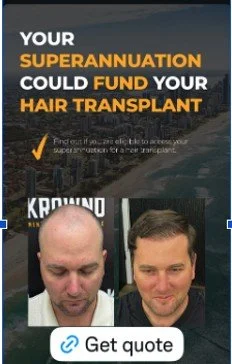
Huh?
In 2024, Australians lodged more than 90,000 applications to raid their super early on compassionate grounds. Over a billion dollars was released, mostly for medical costs. Authorities are now calling out businesses that push people toward overly expensive or unnecessary treatments funded by their retirement savings.
And some of those treatments include hair transplants.
Apparently this now falls under ‘mental health’.
Right.
Getting bum fluff sewn into your head and calling it a mental health necessity is a stretch.
But think about what happens when these blokes are old and grey and finally do the maths. Factor in the tax on early withdrawal and decades of lost compound interest, and that $40,000 procedure can quietly turn into a $200,000 mistake.
All for something that, in most cases, is optional.
My mate can afford it. Plenty of people can’t.
And they’re the ones being sold.
One day they’ll stop working. One day they’ll have to start living off what’s left. And if they’ve been dipping into it early, that moment will arrive with less than they thought.
It’s enough to make you tear your hair out!
Tread Your Own Path!
P.S. We're heading into the school holidays, so I'll catch you in a couple of weeks!
Your Questions & Answers
Dating an Orange Narcissist
Am I Really the Bad Guy?
I Spent $800 on takeout food
Dating an Orange Narcissist
Hi Scott,
A lot of us Barefooters signed up to ING back in the day for the free banking and the good rates. Now I'm reading they've rolled out a paid subscription model overseas, up to $75 a month for the bells and whistles, and Australia's apparently on the list. If ING goes down that road, where are we all supposed to go?
Daniel
Hi Daniel,
I rang up ING (admittedly when I was at the boozer).
"We're not doing it this year," the employee assured me.
So next year then.
After all, the big boss in Europe gave an interview to Bloomberg under the headline: "ING introduces subscription model to lift fee income." It also confirmed our little penal colony was on the list for the gouging.
"He said the quiet bit out loud ... that makes your job hard," I said.
"Uh, yes, it does," he said.
My view?
Banking is a lot like dating a narcissist.
When you first hook up they're all lovey dovey, and low-maintenance:
No bank fees! No ATM fees! High savings rates!
Then they get comfy. And slowly the hoops appear:
"Show me your pay packet if you want a good rate."
"Don't you dare touch your own savings, or my interest in you will... vanish."
They treat you worse every year ... putting out less and less, betting you're too busy to leave.
So where to next?
Well, I had a brief affair with UP, yet they ended up jerking me around as well.
My business banking is with a credit union, but that's kind of like listening to music on a walkman. It's financial virtue signalling, and mostly impractical.
Personally, I'm not playing banking Tinder, swiping right on every outfit that flirts with an extra 0.7%, knowing full well it disappears the second the honeymoon ends.
My view?
ING are not the sweetheart they were when I first wrote my book, but they're no Big Four either.
A subscription fee to hold my money though?
That'll be the day I tell them to pack their bags.
Am I Really the Bad Guy?
Hi Scott,
Both my parents have passed away and I'm inheriting the family home 50/50 with my sister. Neither of us plans to live there. She wants to keep it for sentimental reasons. I want to sell. It's a large acreage with an older house. Mowing, weeds, rodents, the works. And I can't stomach an empty house when people in our community are desperate for somewhere to live. My sister wants to buy me out via a long-term payment plan. But she's already said "you don't really need the money anyway," refused any discussion about terms, and forbidden me from asking about her finances. I've suggested she borrow from a bank instead. She thinks I'm being unreasonable. I'm yet to start a family and this money matters. Why does wanting my fair share make me the bad guy?
Tim
Hey Tim,
Your sister is grieving the loss of your parents, and right now that's guiding her decision to keep the joint.
You also said you're 'about to inherit the home' which tells me it's still pretty raw.
This is what happens mate! It's a totally understandable reaction.
So what can you do?
Give her some time. (You've got two years from the date of death before Capital Gains Tax kicks in.)
The reality of maintaining an acreage property is a pain in the toosh, and expensive as hell. So give it six months.
At the same time I'd find a way to honour your parents and your family. Maybe it's starting a new tradition, a yearly long weekend retreat that the entire family goes on. Or perhaps it's a donation in their name.
My wife's late father was a teacher. Each year she and her brother go back to his old high school and present a prize to a student in his name. It's sentimental, meaningful and hopeful all wrapped up in one night.
Better yet, ask her for some ideas.
You're not the bad guy. You're her brother, and with a little support you can help her with her grief, and help her use the money to honour them. That's the legacy they'd be proud of.
I Spent $800 on takeout food
Scott,
In 2021 a friend recommended your book to me. I was in a bad place, in a relationship that was incredibly abusive, emotionally and financially. I read it that Christmas and went through my spending. I was spending $800 a week on takeout because my cooking was "too shitty" for him to eat. After I'd worked a full day and he'd spent it gaming because "no one is hiring babe."
That was a devastating wake-up call. I restructured my spending and started saving. By the end of 2022 I was free. Tonight I got my end of financial year bonus. I've officially hit my 20% deposit goal, Scott. I can buy a home. I am happy crying right now. I have six months of expenses saved, a healthy ETF account, and I am free.
Sara
Hey Sara,
Hallelujah!
There is so much doom and gloom right now.
The government. Capital gains tax. The cost of living. All very real speed bumps. Yet the algorithm of outrage makes them feel like dead ends.
Not you, Sara.
You were in a genuinely awful situation. A bloke who wouldn't eat your cooking and wouldn't get a job.
Yet instead of staying stuck, you opened a book, set up some buckets, and followed the plan.
Year one you sorted yourself out.
Year two you walked out the door.
Year five you're happy crying over a deposit.
That is its own special kind of compounding.
I've answered thousands of letters over the years. What I've found is it takes most people about 12 months to sort themselves out, and around six years to become financially bulletproof.
Not many people follow a plan for five years. But the ones who do get moments like this.
A home deposit. Six months of expenses in the bank. An investment portfolio ticking away in the background. And something far more valuable than all of them:
Freedom. Well done. Enjoy tonight. You’ve earnt it.
Thanks for reading,
Scott
Bank CEO is OUTRAGED
Another one of your predictions is coming true, with the Government planning on scrapping surcharge fees. I read in the paper today that the NAB CEO said he was horrified after he was slugged with a 10% surcharge for a coffee! Change is coming!
Hi Scott,
Another one of your predictions is coming true, with the Government planning on scrapping surcharge fees. I read in the paper today that the NAB CEO said he was horrified after he was slugged with a 10% surcharge for a coffee! Change is coming!
Krishna
Hi Krishna
Wake up and smell the coffee!
Up until now the Government hasn’t given a frappé-latte about the billions of dollars in surcharge fees we’ve been slugged over the years.
So what’s changed?
Albo knows he’s in more muck than a Werribee duck, and he needs to do something about the cost of living before the coming election.
Then there’s the (new) NAB CEO. If he meets his target this year, he’ll earn $5,000,000. Do you really think a 50 cent surcharge is enough to blow the froth off his coffee?
Please.
Look, until they ban surcharge fees, the only hope of getting around the percentage-based surcharge is (annoyingly) to pull out your card and stick it in the machine, or swipe and select ‘cheque’ or ‘savings’ to go through the EFTPOS system, which means you hopefully will be charged only 30 cents or so for the transaction.
Scott.
A warning to anyone who taps their card
“Would you like your receipt?” asked the cashier at my local IGA. I shook my head. I always shake my head. After all, most receipts are a waste of paper and ink. And I know that if I do take one, just to be nice, I’ll shove it in my pocket and it’ll invariably end up going through the wash and Liz will yell at me.
“Would you like your receipt?” asked the cashier at my local IGA.
I shook my head. I always shake my head.
After all, most receipts are a waste of paper and ink. And I know that if I do take one, just to be nice, I’ll shove it in my pocket and it’ll invariably end up going through the wash and Liz will yell at me.
In fact, if I’m buying something cheap these days I don’t even hang around to get asked the question.
I’m tapping, and I’m going!
As soon as I hear the ‘beep’ I’m off. “Stop me if it doesn’t go through”, I say as I charge out of the store.
Yet this week I got a shocking letter that has made me slow the hell down at the store.
Hi Scott,
My husband did a silly thing. He often goes to a local bakery for a chicken sandwich, paying with his debit card. Last week, he did his usual routine: ordered, tapped his card, entered his PIN, picked up the sandwich, and continued on with his day.
Over the weekend, he noticed the bakery had charged him $1,300, not $13. He called the bakery, thinking it was a mistake. However, the owner accused him of being a scammer and refused a refund!
He then disputed it with the bank. The bank said that entering his PIN meant he had authorised the charge. So we’re now out $1,300 for a sandwich!
Natasha
Struth!
Talk about a sh…nitzel sandwich.
Thankfully my bank flashes up the transaction on my Apple watch and phone after I leave the store.
Your husband should definitely get that feature.
Yet here’s what I’d do about your situation.
First, I’d gather the evidence: get the bank to verify the merchant was indeed the bakery, and then print off the statement. I’d hand it to the bakery and ask very politely that they reverse the transaction.
And if they refuse, I’d tell them that your next stop is to the police station where you’re intending to press charges for theft.
Tread Your Own Path!
Which app is screwing you?
Imagine if the maps app on your phone was ‘dodgy’. Without you knowing it, Google directed you to routes with toll roads … because they got a kickback from the toll road company. Outrageous, right?!
Imagine if the maps app on your phone was ‘dodgy’.
Without you knowing it, Google directed you to routes with toll roads … because they got a kickback from the toll road company.
Outrageous, right?!
Well, according to Small Business Ombudsman Bruce Billson, that’s what’s happening … with another app on your phone.
Can you guess which app is screwing you?
(Drum roll.)
That’s right, it’s your bank app. (It’s always the bloody banks.)
Here’s the sting:
Since we all became germophobes, tap-and-go payments have exploded. In fact we Aussies are now the biggest users of contactless payments in the world, according to banking research firm RFI Global.
Yet what most people don’t know is that, when they tap, their bank generally defaults that payment through Visa or MasterCard, who pays them a fee – instead of defaulting that payment through the much cheaper bank-owned EFTPOS.
Talk about a rort!
Getting slugged a surcharge of up to 2% on every transaction could be costing you upwards of two hundred clams a year (collectively a $1 billion-a-year rort, according to the Ombudsman).
So let me suggest two quick ways to make it much less likely you’ll be charged:
First, change your default payment on your phone.
On an iPhone, open ‘Settings’, go to ‘Wallet & Apple Pay’, then tap your debit card. Then look for ‘Payment Option’. It will generally have ‘MasterCard’ or ‘Visa’ preselected, but instead you should select ‘eftpos SAV’. (Not all cards allow you to do this, and if you’re on an android you’ll need to check with your bank, because it’s a bit tricker apparently.)
Second, pull out your physical card.
I know it’s annoying, but if you swipe and insert your card you can choose ‘cheque’ or ‘savings’ and it’ll go through the EFTPOS system, which at the bigger retailers means you’ll be less likely to be charged.
Here’s the problem though.
Let’s say you’re at my local fish’n’chip joint, which has a sign on the till that reads:
“Surcharge 1.5%.”
The 16-year-old goth with the nose ring and bad attitude doesn’t understand the intricacies of banking payment systems, nor the fact that you’ve chosen EFTPOS, which will result in her employer being charged less in fees. She’s going to hit you with the fee, because, well, just because.
So here’s what really needs to be done:
The Government needs to ban surcharges … the same way they have in the US and the UK.
That’s a rolled-gold vote winner a year out from an election, right?
(Hello, Minister for Financial Services Stephen Jones and Shadow Minister Luke Howarth!)
Tread Your Own Path!
ING Totally Sucks!
Let me count the ways that ING sucks. Their customer service absolutely sucks.
Hi Scott,
Let me count the ways that ING sucks. Their customer service absolutely sucks. Their security sucks (a four-digit passcode, really?), and now they are dropping their international ATM rebate, which TOTALLY sucks because I’m heading overseas soon. Are you still in the ‘orange army’ or, like me, do you think it sucks too much?
Angela
Hi Angela,
So I had my own sucky experience with ING a while back.
They called my wife about suspicious transactions on our account.
It turned out the suspicious transactions in question were actually payments we received.
Odd, right?
Yet it gets odder.
The dude from ING kept asking what the payments were related to, and my wife answered that she honestly had no idea. Then I remembered I’d sold some sheep troughs on eBay, and that was the transaction in question. It was all very … sheepy.
So what do I think of ING?
Well, these days ING is a lot like U2. The Joshua Tree was an awesome album, edgy and original … but now they’re just a little bit same, same, lame. There are better accounts on offer.
Still, their online saver is currently paying 5.25%, and they don’t charge transaction fees. And as for them ditching the foreign ATMs, well, I’m as likely to use that as I am to listen to All That You Can’t Leave Behind.
Scott.
Is My Money Safe?
With another bank failing in the US, it’s starting to feel like 2008/2009 once again. How safe are our banks, and our money in the banks?
Hi Scott,
With another bank failing in the US, it’s starting to feel like 2008/2009 once again. How safe are our banks, and our money in the banks?
Jenny
Hi Jenny,
Don’t worry, the money in our banks is safe.
The government’s Financial Claims Scheme protects depositors up to $250,000 per account holder should your bank, building society or credit union go belly up. (And if you have a joint account, each account holder is entitled to the guarantee.)
But it only applies to one account at a particular institution. So, if you’ve got more than $250,000 you should think about spreading it around different institutions, so you’re covered by the scheme.
Scott
How to earn 3% on your savings
There’s a new app called Blossom that just has popped up. It’s still in the testing phase, but my fiancé has been invited to test it out. It’s targeting 3% returns on savings, and you can deposit and withdraw money at any time without any fees.
Hi Scott
There’s a new app called Blossom that just has popped up. It’s still in the testing phase, but my fiancé has been invited to test it out. It’s targeting 3% returns on savings, and you can deposit and withdraw money at any time without any fees. It’s apparently a fixed-income investment without the restrictions of being locked in long term, like with other investments, and it’s backed by JP Morgan. It almost feels like an external high-interest-earning savings account. In the current climate of very little interest earnings on other normally high-interest-earning savings accounts, this all sounds very appealing for parking your savings in. So ... what’s the catch?
Cheers, Belle
Hi Belle,
I took a look at Blossom and it has a very Gwyneth Paltrow candle-like vibe to it:
“Plant the seeds and watch your savings Blossom each day”, whispers the pastel-coloured website.
In fact, the only thing I think you’ve planted, Belle, is this question.
Level with me: you work for Blossom right?
After all, what sort of reader says “it almost sounds like an external high-interest-earning savings account”?
Anyway, the catch with Blossom is that you are not protected by the Government deposit guarantee (of up to $250,000). In other words: if things go bad, you could lose your money.
Will they go bad? I have no idea. Generally, fixed-income investments are quite secure.
Still, the fact is that you’re taking on more risk, which is why they’re targeting a higher rate of return.
And that’s the rub: while they’re targeting a 3% return (after their fees) — that’s not guaranteed.
So the question you need to ask yourself is a simple but important one:
“Am I willing to take the extra risk to earn at best an extra 1.5% per annum?”
Personally, I’m not. It’s just not enough of a return to justify leaving the warm embrace of the Government.
Scott.
Reminder: I first wrote about this years ago and highlighted the low costs. Today there are better deals on offer. How do I know? Because my readers constantly email me about them! So before you do anything, do a quick google.
Following My Dream
I am trying to follow my dream of buying my own home before I turn 30, even though I am on an average wage. But my accountant recently put me in touch with his property advisory team and they are adamant I should buy an investment property (with their help) as a way to pay less tax.
Hi Scott,
I am trying to follow my dream of buying my own home before I turn 30, even though I am on an average wage. But my accountant recently put me in touch with his property advisory team and they are adamant I should buy an investment property (with their help) as a way to pay less tax. It has got to a point where I have started ignoring their calls as they just will not listen to me. Am I being too stubborn or am I doing the right thing?
Tash
Hi Tash,
Interesting predicament.
Here’s what I’d email your accountant (feel free to use it):
Dear Mr Accountant,
I’m breaking up with you and your firm, effectively immediately.
It’s not me, it’s you … and your salesmen mates who keep hassling me.
Seriously, they remind me of a desperado date I’ve been on before (I know they only want one thing, and they won’t take ‘no’ for an answer).
It’s all a little creepy and, dude, I just don’t need that from my bean-counter.
Regards, Tash
If you have an uncomplicated set-up (pay-as-you-go job, no investment properties), you should be able to complete your tax return with myTax through myGov. And if you need to maximise your deductions, check out the ATO’s myDeductions app.
Put the money you save towards your house deposit, not these clowns.
Scott.
Teenage Terms and Conditions
Recently my 13-year-old son received a letter from the ANZ bank with a new debit card and the promise of a PIN to follow. The problem is, his mum and I knew nothing about it!
Hi Scott,
Recently my 13-year-old son received a letter from the ANZ bank with a new debit card and the promise of a PIN to follow. The problem is, his mum and I knew nothing about it! My son had organised the whole thing by himself, from the initial online application to the in-branch ID verification. We were horrified — how is this possible? So I went with my son to the bank and asked the teller if this was true. They called the manager, who said ‘yes’. I still don’t believe it!
Chris
Hi Chris,
I spoke to the ANZ and they said:
“Customers from 12 years old are able to open an everyday account; however, we only offer EFTPOS cards rather than VISA debit cards for anyone under the age of 14 years.”
In other words, they’re like any business looking for customers. And their aim is to convert these kids into highly profitable customers, which is where the problems begin.
Sure, it would be dandy if all the banks signed a charter that they won’t push products on kids under the age of, say, 21. Yet that’s a pipedream. Besides, there are plenty of other sharks that will bite our kids (hello Nimble).
A more practical approach is to build the financial confidence of every Australian kid before they leave school.
(I’m working on that.)
But, Chris, this isn’t about ANZ. Please don’t make it about them.
This is about your son being a total go-getter.
Seriously.
You should be bragging about his initiative to anyone who listens. Let him overhear how proud you are.
How many parents of a teenager would LOVE to have this problem?
In my book The Barefoot Investor for Families, one of the challenges in the Barefoot 10 — the 10 things you want your kid to do before they leave home — is to set up a low-fee bank account. Another is giving them your utility bills and bank bills and paying them a commission if they can get a cheaper rate.
Embrace it!
Scott.
ING Makes Life Difficult
Today I received an email from ING (I am sure you did too) saying that in March 2021 there would be an extra criterion to meet to get the best interest rates for the Savings Maximiser — at the end of the month your balance has to be more than what it was at the start of the month.
Hi Scott,
Today I received an email from ING (I am sure you did too) saying that in March 2021 there would be an extra criterion to meet to get the best interest rates for the Savings Maximiser — at the end of the month your balance has to be more than what it was at the start of the month.
What annoyed me was that it was framed as a great opportunity for customers to save, even though it is clear the bank wants to make more money and pay less interest! I called ING to give my feedback and was told it is what all the banks are doing. Is that true?
Full disclosure: I am someone who will be disadvantaged by this for a time as I will be going on maternity leave. We have saved hard into our ‘Fire Extinguisher’ account to cover the period I won’t be working. We won’t be able to save more during this time, meaning we won’t qualify for the best interest rate. Maybe I am getting more worked up over this than I need to be, but I would appreciate your perspective!
Bec
Hi Bec,
This move by ING reminds me of a girl I once dated at uni.
When we began dating, things were simple, open and transparent.
Yet it got way more complicated as time went by ...
“Are you going to the pub to avoid me?”
“Don’t you dare pat my cat like that.”
And my favourite: “What do you mean when you say ‘good morning’?”
In the end, there were so many emotional hoops to jump through, it all became too freaking hard.
ING is fast becoming like my ex-girlfriend.
I was attracted to them because of the simplicity: they paid a leading interest rate, with no fees.
Unlike other offerings, they didn’t play those teaser rate and ‘bait and switch’ games.
Well, until now.
Their marketing guys have obviously decided they’ve got enough customers, so from March 1 they can afford to burn off a few, and trust the majority will stick.
So, Bec, I called up ING and spoke to them on your behalf.
They told me they plan on paying a higher rate of interest than they are now (though they wouldn’t confirm how much it would be).
They also said, “You know, Scott, technically you could transfer a single dollar and still get the interest”.
Yet that just gave me flashbacks to my uni dating days.
I mean, why make us jump through hoops? We’re already going steady!
So, Bec, what to do?
Well, many people may be better off with ING’s higher rate. But in your situation, you’re probably better off with UBank, Up, or even ME Bank, who don’t (yet) play these silly games.
Scott.
Reminder: I first wrote about this years ago and highlighted the low fees. Today there are better bank accounts on offer. How do I know? Because my readers constantly email me about them! So before you do anything, google the best accounts on offer now.
My eye-watering returns
When I look at my bank balance these days, I have the same reaction as getting a COVID test up the schnozz:
Eye-watering pain.
See, as a lifelong saver, it pains me to see the amount of interest I’m earning on my so-called ‘high interest online savings accounts’
When I look at my bank balance these days, I have the same reaction as getting a COVID test up the schnozz:
Eye-watering pain.
See, as a lifelong saver, it pains me to see the amount of interest I’m earning on my so-called ‘high interest online savings accounts’: a tearful 1.5% per year. On a lazy 10 grand that’s a whopping $150 a year.
Ouch!
But I guess that’s better than nothing, right?
Actually it’s worse: after I pay tax on the interest, and then account for prices rising (inflation), I’m in the red.
Yep, the money I have in my savings account is guaranteed to lose me money.
And remember, that’s with me earning a (relatively) decent 1.5% per year. If you’re saving with one of the Big Four, you’re probably not even earning half that. According to comparison site Mozo, over the last six months banks have cut the interest on 1,479 savings accounts and term deposits. And they’re likely to keep cutting, with the Reserve Bank of Australia (RBA) considering another rate cut as early as next month.
When will it end?
The RBA has said that it expects rates will be low for the next three years. At least.
Pass me a hanky, Daddy’s got a nosebleed!
Yet don’t cry for me Argentina. Of all the people who write to me, there are two groups I feel most sorry for: young people saving for a house deposit, and retirees trying to live off term deposits.
While they’re at opposite ends of the limbo stick of life, they both ask me the same question:
“Should I invest some of my savings in the sharemarket?”
You can see their logic. After all, the week after last the share market went up over 5%.
In a week!
However, my answer is always the same:
Never invest money in the share market that you’ll need — or think you may need — in the next five years. It’s just too risky. Chances are you could lose a chunk of your money. When you think of it that way, 1.5% doesn’t sound so bad after all, right? So keep your short-term cash in a boring savings account that’s covered by the government guarantee (up to $250,000).
Still, I know it sucks.
To deal with the post-traumatic stress of low rates, I’ve had to reframe the role that cash plays in my financial life. What cash buys me most is peace of mind. It gives me options in a time of crisis. And if there’s one thing we’ve learned in 2020, it’s that the world is a very unpredictable place.
And that’s the rub: interest rates are said to be at their lowest levels in 5,000 years (and remember the pharaohs didn’t even have AfterPay). This is discouraging people from saving, and encouraging them to borrow up big and take risks. History tells me this will (eventually) end in tears.
Tread Your Own Path!
Newsflash: CommBank Sucks
Scott, I have just received an email from the Commonwealth Bank that has left me furious. Without my consent they have reduced my home loan repayments to the minimum amount, to ‘help’ me during COVID-19.
Scott,
I have just received an email from the Commonwealth Bank that has left me furious. Without my consent they have reduced my home loan repayments to the minimum amount, to ‘help’ me during COVID-19. This change is promoted in the email as coming from the goodness of their community-spirited heart. I am gobsmacked there is not even an ‘opt out’ button. Instead you have to wait until May to change repayments back to the level you want, by which time most of us will have forgotten, and will then coast along for the next 20 years paying more than we should. Is this as dreadful an act of corporate greed dressed up as charity as it seems to me?
Belinda
Hi Belinda,
No, I think you’ve nailed it.
Last year Commbank crowed about their plan to spend $5 billion on technology to serve their customers better.
Look, I’m no geek, but surely that’s enough dough to make a button appear on your internet banking that says:
“Click here if you want to reduce to making minimum repayments because of the Corona Crisis. Otherwise continue making higher repayments, you bloody legend!” (Or something like that.)
This behaviour reinforces my golden rule: don’t get between a bank and a bucket of money.
So what can you do?
Well, if you’re employed, right now is a once-in-a-lifetime opportunity to get the banker off your back. And, as I’ve long said, there are only two ways to pay off your mortgage faster:
Make extra repayments (well, CommBank have temporarily buggered that one), or get a lower interest rate.
So check out online lenders, some of whom are 20% cheaper (or more) than CBA’s standard variable offering.
It’s almost as easy as clicking a button.
Scott
Are the Banks Going to Collapse?
Hi Scott,Do you think any of the banks could collapse? I've heard people saying we should remove our savings.
Hi Scott,
Do you think any of the banks could collapse? I've heard people saying we should remove our savings. Won't that make their closure more likely? What's your advice?
Brad
Brad,
I’ve been getting this question a LOT this week. It’s actually quite understandable in the current environment where people are being tasered for toilet rolls. However, the answer is ‘no’, I don’t believe the banks are going to collapse. And even if one did, the Government stands behind them with its $250,000 guarantee on authorised deposit-taking institutions. So there is no need to start stashing your cash alongside your toilet rolls.
Scott
Help! I'm with 28 Banks
Hello Scott, I am with 28 different banks (including credit unions). Some charge monthly, some are purely online.
Hello Scott,
I am with 28 different banks (including credit unions). Some charge monthly, some are purely online. I was wondering what you would recommend as a single bank — who I’m probably with already — to consolidate it all together. I am also with MyBudget, who are helping me with my unpaid bills. I am 35 years old and earn $82,000. What should I do?
Brad
Hi Brad,
You seriously have 28 different banks?!
What do you use for a wallet — a suitcase?
People see you down the street: “There’s Brad at the ATM again, rifling through his suitcase of debit cards ... trying to remember which one has the money on it.”
Then again, some people collect stamps, or tattoos, or husbands, so whatever floats your boat.
Now you can have 28 banks if you really want … but one MyBudget is way too many.
MyBudget is just awful.
If you’re broke and can’t pay your bills, you sure as hell can’t afford to spend thousands of dollars a year on a glorified budgeting app. (I wonder if MyBudget suggests that their expensive ongoing fees are the most important bills that need to be paid?!)
Now, after years of promiscuous banking, you want my advice on being a banking bachelor?
Well, you should give your rose to whichever bank you want. After all, all authorised deposit-taking institutions (ADIs) are covered by the Government’s deposit guarantee up to $250,000, and none pay any interest worth crowing about these days. Yet if you really want to get a handle on your money you need to focus: after you’ve chosen your one and only, set up different savings and spending buckets, and begin banking on yourself.
Scott
Problems with ING
Hi Scott, Last week my husband and I were hit by scammers, who “ported” (transferred) all our business mobiles from Telstra. We contacted Telstra, who assured us that our mobiles could be recovered, and that they would report the matter to their fraud department.
Hi Scott,
Last week my husband and I were hit by scammers, who “ported” (transferred) all our business mobiles from Telstra.
We contacted Telstra, who assured us that our mobiles could be recovered, and that they would report the matter to their fraud department. Little did we know what was to happen next … The scammers found our details on social media, and once they knew our dates of birth and address they hit all our bank accounts.
Thankfully, ANZ and CBA blocked them first go. Yet ING gave them access to all our accounts! With ING, all the scammers needed was to recover the customer number: there were no security questions asked — maiden name, school I attended, favourite pet, nothing!
All our savings, including our redraw facility, were drained within three days: a total of $15,000.
ING does have an “online security guarantee” but they are not honouring it because we did not notify them on the day our mobile was scammed!
I know you are one of their biggest supporters, but after banking with ING for 15 years (and I must admit it’s the best little savings account I’ve ever had) I’ve now lost all respect for them.
Please help me to get ING to upgrade their security. After all, what are the security questions for if you don’t need to use them?
Gina
Hi Gina,
What a horrible situation!
Now let’s get a couple of things clear:
First, I have zero association with ING, other than being a fellow customer.
Second, what you’re talking about is identity fraud, which affects thousands of people (and every major bank).
Still, I called ING and asked them, “Why doesn’t ING ask security questions like the other banks do?”
They told me that they have disabled their online retrieval function, which means that they now force customers to call the contact centre, where they are faced with additional security questions.
They also assured me they had a dedicated team that constantly monitored and updated their security. Finally, it is totally outrageous that they declined to refund you … so I asked them about that too. Thankfully, they have now agreed to fully reimburse you for your losses. As they bloody well should.
Scott
Reminder: I first wrote about this years ago and highlighted the low fees. Today there are better bank accounts on offer. How do I know? Because my readers constantly email me about them! So before you do anything, google the best accounts on offer now.
I Am Adrian’s Mum!
Hi Scott, In response to your column last week about the Commonwealth Bank’s school banking program, I am “Adrian’s mum from Year 4” and I’m also the school banking co-ordinator for the primary school. Yes, I am a volunteer.
Hi Scott,
In response to your column last week about the Commonwealth Bank’s school banking program, I am “Adrian’s mum from Year 4” and I’m also the school banking co-ordinator for the primary school. Yes, I am a volunteer. In fact there are four of us who volunteer on a regular basis. Even though I run the program, I support the idea of removing big banks from school banking programs and have watched with interest the changes you are trying to make in the sector. But the one thing that keeps the program going at our school is the kickback from the bank — around $800 a year. It is more than some of our other fundraisers! Anything that brings in dollars to the P & C is going to be difficult to get rid of.
Rita
Hi Rita,
I totally understand that the money Commbank pays cash-strapped schools is welcome.
Yet the point is it comes with strings, and it’s your kids who’ll pay for it in the end.
Part of my submission to ASIC will raise your point, and I’m going to add that we need the government to put some money into this.
I’ve always said the CBA understands the value of our kids — it’s time our government did too.
Scott
Tired of earning less than 3% on your money?
I’ve got an old bloke who comes out and services my tractor. Mostly we talk about hydraulics, but the other day he rifled through his overalls and pulled out an ad he’d ripped from a newspaper.
I’ve got an old bloke who comes out and services my tractor.
Mostly we talk about hydraulics, but the other day he rifled through his overalls and pulled out an ad he’d ripped from a newspaper. Then he handed it to me with his grease-stained hands.
The ad was from an outfit called “IPO Wealth”, whose tagline is: “Are you tired of earning less than 3 per cent p.a. on your idle money?”
“They’re paying 5.3 per cent for a 12-month term deposit,” my mechanic mate said.
(It turns out he’s an old cocky who has the proceeds from the sale of his farm invested in low-earning term deposits, which is enough to qualify him as a “high net worth investor” suitable to invest with IPO Wealth.)
I studied the ad, which had a picture of a Great Dane towering over a hairless chihuahua.
“What do you think?” he asked.
“I think you’re the chihuahua!” I laughed.
He did not.
“But it’s a term deposit … so it’s safe, right?” he said tentatively.
“Well, that depends,” I replied. “Where will they invest your money?”
He shrugged his shoulders. I shrugged my shoulders.
Then he snatched the paper back from me, stuffed it in his overalls and turned back to the tractor.
Awkward.
So later that night I did some research.
It’s clear that IPO Wealth is marketing its product as an alternative to term deposits.
“The fund is considered by our investors as an attractive alternative to term-based investments, investment property and stock market investments”, their website says.
And it’s clear they’ve spent a shedload of money on advertising, including creating infomercials with appealing retired women talking about their investments with IPO Wealth.
And it’s also clear it’s working: IPO Wealth says it has taken $100 million in deposits in the past two years.
So where is all that money invested?
Well, it’s hard to tell. The fund lends depositors’ money on to a related party, a privately held investment group called Mayfair 101.
Mayfair 101 says its policy is “not to publish a list of its entire investment holdings as many of these assets are private companies”.
Bugger that!
So I got on the phone and spoke to them directly, and they confirmed that Mayfair 101 has spent $31.5 million buying Dunk Island (an island south of Cairns that was wiped out by Cyclone Yasi in 2011) and has also invested in various cryptocurrency-related companies, a food app, and a host of other investments across 11 countries.
My old mechanic mate clearly didn’t understand that this was not a traditional bank term deposit (which would be covered by the government’s bank deposit guarantee if something goes wrong).
Yet I totally understand his frustration: with interest rates at all-time lows, it’s bloody hard for retirees trying to live off their interest.
My worry is that income-poor retirees could be sold a pup:
They may believe they’ve got a Great Dane guarding their money … only to find out later it’s a hairless little chihuahua.
Tread Your Own Path!
It’s time to knock out Dollarmites
Today I feel like a financial Rocky Balboa. See, I’ve been fighting CommBank’s Dollarmites for 15 long years … and haven’t so much as landed a punch.
Today I feel like a financial Rocky Balboa.
See, I’ve been fighting CommBank’s Dollarmites for 15 long years … and haven’t so much as landed a punch.
By rights, my trainer should have thrown in the towel and put me out of my misery.
After all, I’ve been fighting a $142 billion company, with 50,000 employees.
Yet I am the Italian Stallion (or the Barefoot Brawler?), so I kept on fighting!
And like all good cliched underdog stories, I’ve finally landed my first punch:
ASIC has officially launched an inquiry into school banking and is inviting public submissions.
Bam! Right on the kisser!
The deadline for entries is 31 October, so I’m busy writing a ‘knock-out’ submission.
Yet to do that, I need a favour from you.
I want your thoughts on Dollarmites. All you have to do is complete a two-minute survey on my website: barefootmoneymovement.org.au
I’ll include all reader responses as part of my submission.
Oh, and there’s one more thing.
While I’ve written War and Peace on Dollarmites, I’ve never actually seen it from the inside — that is, I’ve never run a Dollarmites school banking program.
How can I do a killer submission without having seen the other side of the coin?
Here’s the story: CommBank’s school banking program may reportedly be worth $10 billion to the bank, yet they’re such scrooges they don’t even pay people to run it!
Instead, the school has to rope in Adrian’s mum from Grade 2 to run the program as a volunteer.
Yes, Adrian’s mum is the bag lady for a bank that made $8,600 million in profits last year!
Well, Adrian’s mum, you can relax and get a mani pedi. I will personally volunteer to come to your school and run the program for a week.
(Disclaimer: I’m not giving away any stupid corporate-coloured toys and I’m not wearing a mascot suit, though I’m happy to teach your students and teachers my version of financial education.)
They’re on the ropes: it’s time to get the eye of the tiger!
So, Barefooters, head over to barefootmoneymovement.org.au and fill out the two-minute survey. (And if you want me to run your school’s Dollarmites program for a week, let me know that as well.)
Help me do it for Adrian!
Tread Your Own Path!
My Bank Gave Me $25,000
Hi Scott, I am 24 and started my first full-time job this year, as a graduate teacher. I am travelling soon and my parents recommended I get a credit card for emergencies.
Hi Scott,
I am 24 and started my first full-time job this year, as a graduate teacher. I am travelling soon and my parents recommended I get a credit card for emergencies. As a Barefooter, I have never had a credit card, only debit. But, as I am planning to have it for travel, not long term, I applied for a fee-free credit card through my bank, ANZ. I have no credit history, no loans (other than HECS), and no assets other than my savings. Lo and behold, ANZ gave me a $25,000 limit! I was stunned.
Penny
Hi Penny,
Sweet Mary Magdalene!
If you were normal, you might be tempted to max that sucker out.
And if you were normal enough to do that, you’d probably be normal enough to make only the minimum repayments, which (according to the ASIC calculator) would take you … 58 years to pay off, and close to $100,000.
So you’d be debt free when you were 82 years old!
However, I’ve got a feeling you’re anything but normal (the fact that you’re emailing me is a good sign). I’m sure you understand that the bank’s aim is to get you into as much debt as they can, for as long as they can.
If you want to cover yourself for emergencies while travelling, here’s what I’d do instead:First, make sure you have adequate travel insurance, and some cash set aside for travel emergencies.
Second, call the bank and make them lower your credit card limit to, say, $5,000 for your trip, and then close it immediately when you get home.
Don’t get sucked into the idea that a high credit card limit helps your credit score: if anything, these days a high credit card limit hurts your chances of being approved for a loan.
Happy travels!
Scott