Articles & Questions
Every week I publish a fun new article on a money topic I think you’ll find interesting. I also answer a handful of reader questions. Subscribers to my newsletter get to see everything first — but you can browse some of my past articles & questions on this page.
My Best Articles
Not sure where to start? Below I’ve handpicked a few of my favourites. And if you like what you see, don’t forget to subscribe to my free newsletter to get new issues before anyone else!
Search Articles
There's a fake Barefoot Investor. And he's everywhere.
My kid's teacher pulled me up at school drop-off this week
"What's he done now?" I asked, bracing myself.
Turns out I was the one in trouble.
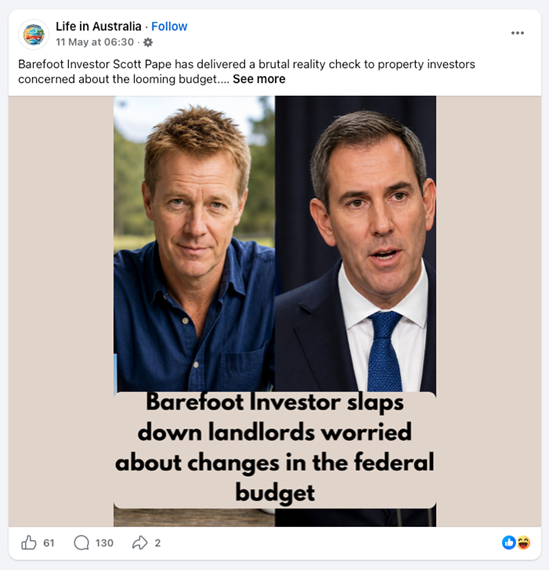
"I saw you on the internet advising people to sell everything because of the budget," she said.
My kid's teacher pulled me up at school drop-off this week.
"What's he done now?" I asked, bracing myself.
Turns out I was the one in trouble.
"I saw you on the internet advising people to sell everything because of the budget," she said.
I'm not even on social media. But there are hundreds of AI-generated posts claiming I am, complete with photos of me looking like a washed-up Blue Heelers extra who never made it out of the pilot episode.
Honest, Miss!
Then again, AI isn't designed to tell you the truth … its sole aim is to keep you coming back.
I know a couple who use ChatGPT as their relationship counsellor. After every fight, they each go to their own bot. And every single time, they're told they're completely right and their partner is the problem.
Separately, they're thriving. Together, they're cooked!
And we haven't just invited AI into the bedroom, it's now in our bank accounts. Today ChatGPT is the largest provider of financial advice in the world. More than 200 million people a month ask it for money advice, and last week OpenAI went further: US users can now hand it the keys to their actual accounts and get tailored financial advice. Australia won't be far behind.
My worry is that ChatGPT is like having your bestie do the job: it’ll tell you what you want to hear.
Ask it to validate the hot stock tip your brother-in-law gave you. It'll find reasons it could work. Ask it to explain why you deserve a boat. It'll build you a spreadsheet. Ask it whether you really need to pay off your mortgage or whether you could just invest the difference in crypto. It will construct a beautifully logical argument for whichever answer you were hoping for.
It's a yes-man with a PhD.
Then again, let's look at the alternative: seeing a real financial adviser will cost you five grand, minimum.
And a lot of people walk out with a template of common sense, and a portfolio so complicated they have no hope of understanding it. Which is exactly the point. Complexity is their job security. That 1% annual fee quietly bleeds you of tens of thousands of dollars a year and almost guarantees you'll underperform a simple index fund.
So you're stuck. A bot that flatters you, or an industry that confuses you on purpose.
Well, here's the third option.
After two decades of writing this column, I can tell you the one thing that separates people who build real wealth from everyone else: they made decisions that felt bad in the short term. They knuckled down and saved up for a deposit when the market was flying. They kept their boring low-cost super when crypto was mooning. They said no when every algorithm and influencer said yes.
Build your career. Boost your super. Pay off your home.
And you don’t need an AI to tell you that.
Tread Your Own Path!
Your Questions & Answers
I will never, EVER read you again
I’m addicted to spending money
Vale Neale Daniher
I will never, EVER read you again
Scott,
I have loyally read your column every week for 20 years. First the sudoku, then straight to you. I've clipped your articles and sent them to my kids and grandkids. Never again.
You are a socialist. A cheerleader for a lying, thieving government elected on a false premise. This budget is drowning in waste, CGT grabs, attacks on negative gearing, small business owners crushed under red tape while politicians throw other people's money around like confetti.
I'm 74. I've seen first-hand what profligate politicians do to an economy. You have no idea what these policies will do to this country, or your own children's future. You’ve lost me, Scott, and judging by the comments under your article, a hell of a lot of your once loyal readers.
Mick
Hey Mick,
Calm your bloody farm!
You've been with me 20 years and you're calling me a socialist?
If you've read me that long, you know I'm an equal opportunity offender. I've never spruiked a political party in my life, and I'm not about to start now.
Here is the guts of what I actually said about the Budget:
Negative gearing, the introduction of the 50% discount on Capital Gains Tax, and falling interest rates combined to price a generation out of the property market. We need to level the playing field.
The government now wants to tax investment profits the same as workers' wages.
And the reaction has bordered on hysteria.
Yet as I showed last week in my column, the changes aren’t actually that radical, and in terms of the new proposal of indexing Capital Gains Tax to inflation, it may work out better for investors than the current 50% discount.
Again, I’ve never voted for the Labor Party in my life. I am not in their pocket. It’s just the facts.
Another fact is that these changes (especially the crackdown on distributing income via trusts), is going to mean I pay more tax going forward.
Yet I still think it's the right call.
Still, we agree on more than you think, Mick: we both want less waste. Lower taxes. Fewer bureaucrats spending other people's money like confetti.
The question is which party gets us there?
Well, that's between you and the ballot box.
Keep enjoying the sudoku Mick. Unlike me it'll never turn commie on you.
I’m addicted to spending money
Scott,
I'm addicted to spending money. Each week I read your replies to people who are married to someone who is reckless with money and you give them advice on how to protect themselves. But it's me, I'm the problem, and my husband has gone to the effort of hiding money from me so I don't spend it (thankfully, or we'd be broke). Is there an "AA" for reckless people like me who want to stop but can't seem to do it? I’m 37, with a good job (earning $140k). However, like any good addict I have all the best intentions (I've read your book countless times) and think "just this last purchase" and then it all slides. I want to stop but I can't.
Ellen
Hi Ellen,
We're all addicted to something.
Online shopping, porn, booze, social media, gambling, political outrage. Or in Mick's case, sudoku.
Yours is spending, and you've admitted it out loud without dressing it up. That's the hardest part.
Here's why willpower won't fix this: you're not weak, you're chasing a feeling. The hit, the relief, the "just this once" that quietly overrides everything you really want to do. Trying harder doesn't rewire that. A good psychologist does. Ask your GP for a referral, someone who works with compulsive or addictive behaviour. CBT is a good starting point.
There's a lot of shame in this kind of cycle. Most people carry it alone. It sounds like your husband is a good man. Let him walk with you.
Vale Neale Daniher
There's been a lot written about Neale this week. As there should be.
In a world of mock outrage and fake influencers, Daniher was the real deal. He was the closest thing this country had to a modern-day stoic — a man who stared down motor neurone disease for more than a decade and chose, every day, to keep fighting.
Here’s something you may not know. He spent his final year not only showing us what true courage looks like, but teaching us: he wrote his last book when his arms, legs and voice had all gone, using eye-gaze technology.
This week I've been reading it to my sons.
Everyone talks about resilience these days, but Neale actually lived it. And in his final book, he shows you how you can do the same.
Buy a copy of The Power of Choice.
Share it with someone you love.
Thanks for reading!
Scott.
You’ll hate this
After reading this column, my editor, Wally, said:
“I’m confident this piece will generate the greatest amount of hate mail you’ve ever received.”
Let’s see if he’s right …
Do you know what the easiest thing I could have done this week was?
After reading this column, my editor, Wally, said:
“I’m confident this piece will generate the greatest amount of hate mail you’ve ever received.”
Let’s see if he’s right …
Do you know what the easiest thing I could have done this week was?
Exactly what every other financial commentator has done:
Lean into the outrage about the budget.
Instead, I’m going the other way. And I’m probably going to piss a lot of you off. Starting with Brian, who wrote to me after what I can only imagine was a solid session on the La-Z-Boy with a few reds:
Scott,
I am just so sick of these incompetent bastards. This budget is just another giant Labor tax grab. People in the top 10% of income earners pay more than half the taxes. Half! Now Albo wants to be a 47% silent partner in every small business in the country. Why would anyone bother? Young people saving for a deposit in index funds? Taxed. Family trusts helping kids through university? Taxed. Small business owners who’ve spent decades building something? Taxed at rates that would make your eyes water.
New Zealand has no capital gains tax. Dubai has no capital gains tax. And our smartest young people are figuring that out real fast. You’ve got the platform, Scott. Let your followers know what’s really going on.
Brian
Bingo-bango, Brian!
You’ve sure got a lot of very big feelings.
Thankfully, I’m a father of four. I deal with big feelings before breakfast.
Let’s get into it.
Brian and I have a lot in common. I’m a high income earner and I pay a lot of tax. I come from a family of small business owners and I run one myself. And I bristle when I see politicians crowing about their economic credentials. The fact is, this is the highest-taxing Australian government since World War Two, and that spending is putting pressure on interest rates that every mortgage holder feels.
Yet what really worries me isn’t the tax take. It’s that our outrage meter seems to be stuck at eleven.
It feels like we’re drifting towards America, where everything is viewed through a political lens and everyone is absolutely furious all the time.
And if we get angry enough we might just end up with Pauline as our PM, and the greatest economic insight she’s ever had was asking “Why can’t we just print more money?”
(Seriously, look it up.)
Anyway, let’s deal with Brian’s three beefs.
Think of the poor kids!
Plenty of young people have written to me in a panic about the changes to capital gains tax. Many were planning to use their share portfolio as a house deposit.
My view?
The CGT change is not their biggest problem.
Let's say a young investor puts $50k into an Aussie index fund. Based on historical returns, it grows to around $72k over five years. Under the new CGT rules, they'd pay roughly $900 more tax when they sell. And depending on future returns and inflation, they might actually come out ahead.
The real problem is the share market dropping 40% and their $72,000 deposit becoming $43,000. Then it takes a decade to recover, while rents keep rising and they’re still at their parents’ place eating their Cheerios. That’s why my rule has never changed: do not save for a house deposit in the share market.
Introducing my new business partner!
Brian’s “47% silent partner” line was funny on social media the first 700 times. Now it’s just annoying. And it’s wrong. The small business CGT concession regime allows the vast majority of small business owners to halve or completely eliminate the capital gains tax they pay when they sell. It’s been there for years (though the thresholds need to be increased).
The real risk is using the tax rate as a reason not to back yourself. Building something from nothing, employing people, serving your community. It’s a hard life. It’s also one of the most rewarding things a person can do. Don’t let a meme talk you out of it.
The family trust
Okay, so this one stings. You see, my kids have been nothing but a spectacular financial loss since the day they arrived. I was counting down the days until they turned eighteen, when I could finally start distributing trust income to them and claw something back. And then the bloody government snapped that door shut just as my eldest was getting close to useful.
Yet it actually makes sense. The system lets wealthy families with good accountants pay less tax than nurses and tradies. That doesn’t pass the pub test.
Finally, if you spend enough time on social media (or listen to Brian) you may start to think that Australia is the highest-taxed nation on earth. Actually, we’re in the middle of the pack, but with a standard of living in the top handful of countries on the planet. The cops don’t shake us down (mostly). Our kids go to decent public schools (mostly). And if one of them gets sick, you don’t need a GoFundMe page.
And what about the top 10% of taxpayers that Brian is so upset for?
We’ll be fine.
After all, we’re the wealthiest people in the country.
Living in one of the wealthiest countries in the world.
At the richest time in human history.
Life is good, Brian, especially when you log off.
Tread Your Own Path!
Your Questions & Answers
Am I Financially Abusing My Brother?
No Show Albo
Am I Financially Abusing My Brother?
Hi Scott,
My brother just divorced his nasty wife. She had access to all his accounts, blew through a $180,000 inheritance, ran up $25,000 on his credit card, and towards the end wouldn’t even let him touch his own debit card. He’s now living with me. He’s on a disability pension and can’t work. I manage his accounts, have set up his savings, and have tried to teach him the basics. He says it’s too hard. My sister accuses me of making it worse. Am I doing more harm than good?
Caring Sister
Hello Caring Sister,
Your brother is lucky to have you.
Your sister doesn’t sound nice, but she does have a point.
(How’s that for having it both ways?)
Now, before you throw me across the room, I know your intentions are completely different from his nasty ex-wife’s. You love your brother. She didn’t. But, from where he’s standing, someone else is still controlling his money, his savings, and his decisions.
Now your bro doesn’t need to become the next Warren Buffett. He just needs to learn to stand on his own two feet again, but that won’t happen while you’re transferring his surplus savings for him.
Think about how this plays out long term. Your brother grows increasingly dependent on you. You grow increasingly resentful … and neither of you need that.
My advice?
Keep helping him with the basics. Set him up with one simple account, show him how to use his card, and then step back. Let him make small mistakes with small money. That’s how people learn. And then, when the settlement comes, he’ll be ready to move out and start his new life. That’s good for him, and great for you.
No Show Albo
Scott,
As a man who lost the family home because of my gambling addiction (a shame I live with every day), and as a father whose teenage son ‘plays’ fantasy football and gets emails and ads from sports gambling companies, I was bitterly disappointed that the government tried to bury their inaction on gambling ads. Did you get a reply from the Prime Minister?
Daniel
Hi Daniel
I wasn’t expecting a reply, and old Albo didn’t disappoint!
He’s the most powerful man in Australian politics. He had the backing from both sides of politics, and the people – nearly three-quarters of parents (myself included) reported being bothered by their kids being exposed to gambling ads.
He had the ability to stand up and say:
“We’ve got a huge gambling problem on our hands, and the beginning of that problem is that sport is a gateway to gambling: today for three in four kids it’s a normal part of sport. That’s crap. I’m the Prime Minister of this country and I’ve had enough. No more bloody ads.”
But he didn’t.
The lobbyists won, the kids lost.
The odds never change.
Thanks for reading.
Scott.
A toxic mix of pain and devastation
This week I was asked to debate whether AI should be used in financial counselling.
I was on the 'yes' side.
Sitting in front of me were 1,000 financial counsellors, arms folded, all thinking the same thing:
This bloke's trying to replace me with a robot.
This week I was asked to debate whether AI should be used in financial counselling.
I was on the 'yes' side.
Sitting in front of me were 1,000 financial counsellors, arms folded, all thinking the same thing:
This bloke's trying to replace me with a robot.
And who can blame them?
Still, this horror movie has been playing for a hundred years, and it always ends the same way:
The job apocalypse has been "five years away" … for the past one hundred years.
Case in point:
In 2016, the so-called godfather of AI, Nobel prize winner Geoffrey Hinton, declared we should stop training radiologists immediately. He said it was ‘clearly obvious’ that AI would replace them within five years.
Today?
There is a shortage of radiologists. Last year there were 4,000 unfilled roles in the US alone.
Why?
Well, AI became their assistant … not their replacement.
Which brings us to today’s hype cycle:
The founder of ChatGPT is warning that AI will be so devastating we'll all need a government handout to survive. I’m highly sceptical … at least in the next five years. I don't know about you, but my interactions with the chatbots remind me of this meme:
Wife: "Did you do the dishes?"
Me: "Yes."
Wife: "Why are they still dirty?"
Me: "You're right to push back on that. I didn't actually do them."
Wife: "I hate you."
Me: "You're absolutely right. This one's on me. Ready to clean?"
The fact is that these language models are three years old: they're still techno toddlers.
Will AI get better?
No doubt. Hundreds of billions of dollars that are currently being invested in AI says it will.
Yet here's what the AI hype merchants miss entirely:
For all the technological advancements, we are lonelier than we have ever been. Anxiety diagnoses have doubled in a decade. Two thirds of us don't trust what we read online, as AI fakes flood our feeds.
We spend our nights sitting alone, heads down, scrolling on our dopamine casinos.
We are starving for human connection.
Which is why a financial counsellor, a real one, sitting across from you, listening without judgement, helping you make sense of your money when your life is falling apart …
Cannot be automated.
AI will crunch the numbers, but it won't hold your hand when everything goes sideways.
And the more artificial the world gets, the more valuable people who actually give a damn become.
Tread Your Own Path!
Your Questions & Answers
New Tax Changes Could Create A Toxic Mix of Pain and Devastation
What’s Your Take on the NDIS?
Barefoot the Crooner
New Tax Changes Could Create A Toxic Mix of Pain and Devastation
Hi Scott,
I'm just reading about the government's proposed changes to capital gains tax in next week's budget. It seems like utter madness from the Labor government that will hit your readers hardest. One expert called it "a toxic mix of pain and devastation" that will force landlords to sell investment properties. And they're doing this during a cost of living crisis when research found that nine per cent of mortgage holders would default if there are one or two more rate hikes. Clearly making things more expensive for landlords like me will make us jack up our rents. It's just commonsense!
Terry
Hi Terry,
I'm not sure if you're from the housing lobby, the Liberal Party, or if you've just stumbled onto my column for the first time in 22 years and haven't worked out that I've spent the better part of two decades arguing against negative gearing and every other form of taxpayer-funded landlord welfare.
For far too long, first home buyers have had the footprints of investors on their backs.
A toxic mix of pain and devastation?
Please.
If that's what happens to your investment portfolio after a few tax tweaks, you've got bigger problems than I can help with.
As for the figure of '9% of mortgage holders at risk of defaulting if there were one or two more rate hikes' ... well, I have a few things to say about that.
First, if they're that skint, they should sell their homes immediately and get out of the market while they still can. They don't own their home. The bank does.
Second, these people most certainly are not my readers.
We're way too smart for that.
What’s Your Take on the NDIS?
Hi Scott,
I'd be keen to hear your thoughts on the NDIS cuts. There are so many strong opinions in my media feeds that this is either … killing people with disabilities, or finally fixing the people taking advantage of the system. What are your hot takes? How does the government either recontextualise the spending as future saving or argue that people with a disability should pay for their own care?
Frank
Hi Frank
I fully support the founding idea of the NDIS: as a nation, we look after people with profound and life-changing disabilities. How we treat the most vulnerable in our society says everything about the values of our country.
However, it's been incredibly badly run.
You kind of expect that with the government, but this has been a cock up of monumental proportions.
There are people who gamed the system and got in early who arguably don't need the support, and now there are genuine cases who are getting knocked back. And then there are billions of dollars of rampant fraud … and our politicians just shrug their shoulders?!
That is not acceptable.
My view?
The entire system needs to be redesigned so it fulfils its original aims. We need to weed out every single fraudster, make them pay back the money they stole, and put the worst of them in the slot.
And, at the same time, make sure the people who genuinely need services get them.
No more shrugging. The NDIS is too important.
Barefoot the Crooner
G'day Scott,
My wife and I read your book, applied the steps, and came out the other side owning everything. Not a cent owed to anyone. You changed the course of our lives, and our kids' lives. Thank you. If you'd been as famous in the 80s as Leif Garrett, I would've had your poster on my wall instead of his.
We're two years from retirement and we've just seen a financial planner, a proper one, Master in Financial Planning, member of the FPA. First thing he said? "You've read Barefoot's book, haven't you?" He's been fantastic. But here's where my gut started talking. He's recommending we ditch our low-fee industry super fund for an ASX-listed fund charging $8,000 a year in fees, with a promise we'll be $100,000 better off over three years. My wife is front row at the Leif Garrett concert, screaming "I Was Made for Dancing." Me? I'm still in the car park. Is this too good to be true?
Lenny
Hi Lenny,
So I googled Leif Garrett. He was quite the dreamboat in his day. Thirty years on though, he looks as washed up as ... me.
Having read and applied Barefoot, YOU are the dreamboat, Lenny. You've done all the hard work yourself and you're now on track for an awesome retirement.
And since you've already mentioned me, feel free to forward this to your financial planner.
In fact, I'll address this to him directly.
Dude.
You and I both know that the only thing you can guarantee Lenny is reducing his nest egg by $24,000 in fees over three years (and then keeping the siphon going on and on until he dies!).
His low-cost industry fund offers dozens of investment options. You could build him an index fund portfolio inside his existing fund and put the $8,000 back in his pocket where it belongs.
Lenny's wife is front row at the Leif Garrett concert ... and you're in the back, rifling through her handbag. Even Leif had more dignity than that. And he's been arrested. Twice.
Thanks for reading,
Scott.